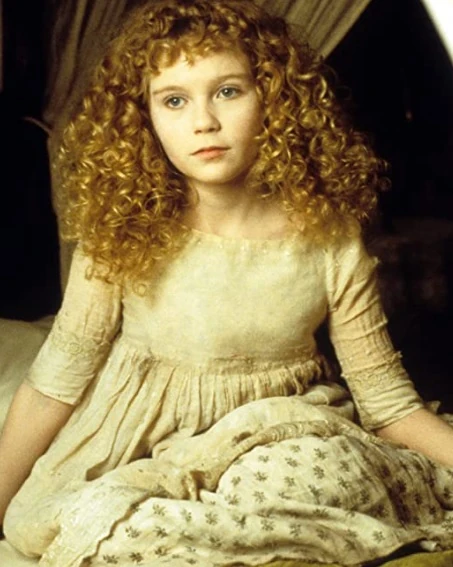
In Anne Rice’s Interview with the Vampire, Claudia is the vampire child of her two vampire fathers, Louis and Lestat. After being found by Louis in a plague ridden home in New Orleans, Lestat feverishly decides to turn her, forever tainting her immortal life as a woman in a child’s body.
As she continues to age psychologically, Claudia yearns to escape her own body. She questions Louis relentlessly with questions about where she came from, if there has ever been another like her, and how Lestat could have done this to her. Consequently, she tries to kill Lestat twice over her anger, but is ultimately unsuccessful. While with Louis in Paris, Claudia escapes Louis for some time and convinces a dollmaker to make her a lady doll, for which she viciously crushes and breaks, frustrated that she will never attain the body of a woman. Claudia is experiencing a sort of repression of womanhood, so that she is maturely a woman forever in the body of a child. Because of her child’s body, her vampire fathers still see her as someone who needs protection and caretaking. She becomes a meditation on what it means to be a different person on the inside than out, relating to how a girl or woman may feel limited by their own body, incapable of expressing themselves as they are or who they want to be. A woman’s objectification is often linked to her appearance, which Rice recognizes as painful and unjust through Claudia’s character.
Claudia is a violent killer, and does not possess any of the lingering human senses that Louis does. Louis fears that she may be “less human than either of us, less human than either of us might have dreamed.” Uncanny as this is, Claudia serves as the female embodiment of what it means to overflow your own boundaries, or escape your own self. She fully embraces her vampire nature, which Louis becomes, at times, jealous of, because he deeply struggles with his own vampiric desires. We see this when Claudia tries to poison Lestat, letting him feed off two human boys whom she has dosed with absinthe.
Vampire culture has a well established subversive family dynamic. When a vampire turns another, the newborn is deemed the vampire’s child, but often acts as their lover as well. We see this in numerous works of literature and film. Think Twilight’s “The Cullen family,” a clan consisting of vampires that live under one roof as a family, but are also broken off into couples. Vampire clans often consist of incestuous relationships, not by bloodline but by way of creation. So, when Lestat turns Claudia, she becomes his and Louis’ child; a child that can never die. Louis and Claudia have a complex relationship throughout the novel, in which he is an emotionally present father figure to her but also, under some light, a lover, although not the sexual kind.
Louis and Claudia bond deeply over their shared hatred for Lestat, and go on together to Paris in search for more of their kind. During their time in Paris, Rice makes several nods to their companionship, describing their love for one another as “sensual.” Louis also notes that “her eyes were a woman’s eyes.” Rice examines a philosophical point that may only be appropriate in that of gothic literature, which is the examination of what matters more, a mature mind or body. In the end, however, Louis chooses the vampire Armand as his companion, and Claudia is killed. Tragic as her death is, especially to Louis, we must wonder if she finally escapes the body that so haunted her during her immortal life, and, at last, overflows her bounds.