Mary Shelley and Frankenstein—A Brief History
Often considered to be one of the most significant pioneers of the science fiction genre, Mary Shelley’s Frankenstein has long since been revered as a cautionary tale on the risks man’s own hubris poses for scientific development, and a commentary on death and humanity. The novel itself was originally written during the summer of 1816, while the then-eighteen year old Mary Godwin was visiting Lord Byron in Geneva alongside her stepsister and lover, Percy Bysshe Shelley (whom she later married). During the introduction to the 1831 edition of Frankenstein, Shelley recalled that the weather was consistently poor throughout the summer, leaving the group to entertain themselves with conversation, writing and storytelling—notably ghost stories. It was then that Byron proposed each of his colleagues write their own ghost story, each with the intent of rivaling one and others. After having initially failed to develop anything she believed could compete against her peers, Shelley later recalled:
“I saw—with shut eyes, but acute mental vision—I saw the pale student of unhallowed arts kneeling beside the thing he had put together. I saw the hideous phantasm of a man stretched out, and then, on the working of some powerful engine, show signs of life, and stir with an uneasy, half vital motion. Frightful must it be; for supremely frightful would be the effect of any human endeavour to mock the stupendous mechanism of the Creator of the world. His success would terrify the artist; he would rush away from his odious handywork, horror-stricken. He would hope that, left to itself, the slight spark of life which he had communicated would fade; that this thing, which had received such imperfect animation, would subside into dead matter; and he might sleep in the belief that the silence of the grave would quench for ever the transient existence of the hideous corpse which he had looked upon as the cradle of life.”
Frankenstein was published anonymously in 1818, two years after Shelley’s trip to Geneva—naturally, it had won the friends storytelling competition. It was published again in 1831 with editorial contributions provided from Shelley’s husband in an effort to make Shelley’s writing come across as more “high-brow.” While she accepted her husband’s suggestions, Shelley remained firm in the fact that Frankenstein was an idea and work of her own creation (audiences initially assumed that Percy Shelley had penned the 1818 edition).
It is often thought that Shelley drew inspiration from her own life when exploring the themes within Frankenstein. Her own mother, Mary Wollstonecraft (a crucial figurehead in the early modern feminist movement) died shortly after giving birth, and Shelley lost several of her own children during pregnancy or infancy alongside her experiences with post-partum depression.
It’s no surprise, then, that Shelley’s attitudes towards personal autonomy, death and rebirth and the human experience shine through in her writing. They are part of what I believe to be one of the more misunderstood aspects of subsequent Frankenstein adaptations. There has oftentimes been a predominant focus on the theme of the dangers of unbridled power, as well as The Creature’s appearance and actions. These intepretations transform him into someone closer to how we might literally define a ‘monster’ than what is actually shown in the book (more on this later). As a result, by reducing the story to something manufactured for pure entertainment or shock value (see: the “It’s alive!” moment from James Whale’s 1931 film) the subtleties of the other themes in the novel are lost. When watching del Toro’s adaptation, it is clear that he tries to deviate from oversaturated Hollywood tropes, which he does with fair success. He hones in on the more emotional aspects of each of the characters’ development—particulalry The Creature’s—and lands on something profound, even if it is not executed in any elaborate manner.
Guillermo del Toro’s Adaptation
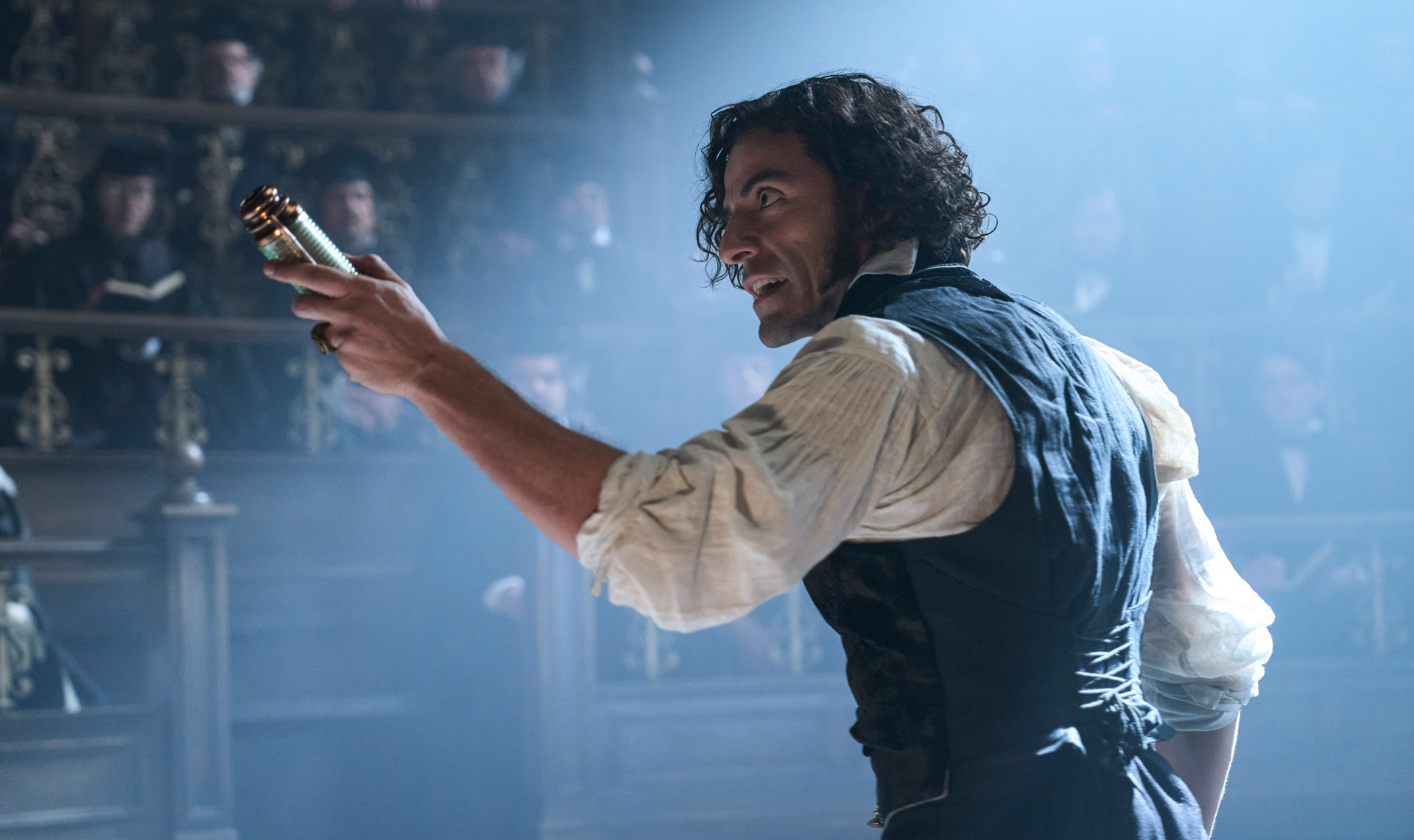
Frankenstein himself is often reduced to the “mad scientist” archetype who sought to tempt fate or God; The Creature is depicted as something abhorrent and terrifying. Both of these renditions are a far cry from the complex and ruminative characters Shelley initially presented us with. However, these tropes are what then make Guillermo del Toro’s Frankenstein adaptation unique—The Creature (Jacob Elordi) is introduced in a similarly violent and monstrous manner, but as the story progresses, is revealed to reflect something more akin to Shelley’s character. By contrast, del Toro depicts Victor Frankenstein (Oscar Isaac) as an egregious egomaniac who wields aggression far beyond that in the novel. In this adaptation, he is almost strangely sinister. His ambitions are a result of his father’s abuse and Victor’s desperation to prove himself to and defy him. His mother’s death, combined with his father’s favoritism towards his younger brother, William, ultimately serve as the driving force behind Victor’s desire for glory, which of course, results in his downfall. Echoes of Victor’s father’s behavior can be seen in his treatment of The Creature throughout the film, whom del Toro very intentionally writes as childlike. Like Shelley’s character, del Toro’s Creature is curious, gentle and flawed, but arguably too sympathetic. This characterization serves as a strong tool to paint contrast between Victor and The Creature, certainly, but by writing Victor as inherently bad against the inherently good Creature, it lacks some of the nuance that Shelley originally achieved.
Victor is by no means a character audiences are intended to root for, but I wouldn’t bestow him with the label of ‘unadulterated villain.’ A lot of his characterization revolves around his desire for companionship and love and to be respected by his peers. It’s what makes his treatment of The Creature heartbreakingly cruel; he fails to set aside that same compassion for his own creation.
Furthermore, a significant part of The Creature’s progression lies in the atrocities he commits as a means of achieving revenge against Frankenstein—namely the murder of Elizabeth, Victor’s fiancee in the novel, and William. In the film, however, William (Felix Kammerer) and Elizabeth (Mia Goth) are engaged, and instead Victor wallows in his unrequited feelings for her for a significant amount of his half of the film, and neither die at The Creature’s hand. He has a fit of outrage in the film, wherein he says, “If you are not to award me love, then I shall indulge in rage,” but little occurs beyond that.
Whereas Shelley highlighted Victor and The Creature’s shared isolation, aggression and vengefulness—perhaps as a means of commenting on paternal neglect and failure—del Toro gives us two characters on overtly different ends of the spectrum. It’s a far more black-and-white interpretation than I would have expected from him. Furthermore, for a two and a half hour long film, The Creature’s characterization felt rather static (again, owing to his overly sympathetic portrayal). Devoting half of the film to ensuring The Creature’s story is told is the most loyal aspect of the film to Shelley’s novel—especially in comparison to other adaptations, many of which focus on Victor’s story alone. There was so much exciting potential in The Creature’s inner turmoil journey that could have been utilized.
Make no mistake: del Toro’s “Frankenstein” is a clear labor of love and still holds many aspects that have made his past gothic films so appreciated. “Frankenstein’s” cinematography, costume and set design, acting are entertaining—despite a few instances of what looks like poorly produced CGI, but, then again, we are suspending our disbelief to watch a man create life from death. del Toro also takes welcome creative liberties through the additions of original characters—namely, Henrich Harlander (Christoph Waltz) an arms dealer who helps fund Frankenstein’s experiments. He also alters some of the story’s location so that it takes place primarily in Scotland as opposed to Switzerland and Germany. With del Toro establishing these deviations during the beginning of the film, it is a given that the story is meant to serve as an adaptation, and not a verbatim rendition. He certainly has a grasp on Shelley’s original commentary on humanity, love and loss. The writing simply falls somewhat flat in regards to subtext, arguably spoon-feeding its message to the audience. (Did we need Victor being outright referred to as “the the real monster” to come to that conclusion?) Elordi’s performance differed greatly in comparison to his prior work, such as “Saltburn” or “Euphoria,” offering audiences with a new insight into his theatrical range and abilities. Waltz and Isaac also had a fascinating onscreen chemistry and the addition of the Harlander character is an interesting casting twist.
Another major but moving deviation lies in the relationship between Elizabeth and The Creature. In the novel, Elizabeth only interacts with him as he kills her; the film takes a gentler approach, with Goth portraying one of the only characters who extends both kindness and patience to The Creature. Her character is almost maternal, and gives The Creature the acceptance and love he desired from Victor. The pair establish a bond that is unique to them alone; it was one of my favorite parts of the film. Goth also plays Victor’s late mother, Claire, whose death, as previously mentioned, serves as a major trigger for the events in his later life. Goth playing both roles reinforces the lasting effects of Victor’s childhood trauma and serves as a link between the two most prominent women in Victor’s past and present. Goth delivers an exceptional performance in each role, but I particularly appreciated the spin on Elizabeth’s character and her resulting resentment towards Victor himself.
The film ends similarly to Shelley’s novel, with the death of Frankenstein, but on a slightly more hopeful and forgiving note. In his final words to The Creature, Frankenstein says, “While you are alive, what recourse do you have but to live?” a line that ultimately sums up the primary theme of del Toro’s film. One of the major pillars Shelley’s novel sits upon is the fact that humans can only wield so much power before it becomes destructive. There are forces of nature that we cannot interfere with, including death; it’s part of what makes life so valuable—it’s finite. This spin on Frankenstein then leaves us with the sole option of exploring different experiences and aspects of humanity: life, death, love and loss. Despite its flaws, del Toro’s adaptation offers an introspective approach towards retelling Mary Shelley’s and well-loved sci-fi classic.
Leave a Reply