
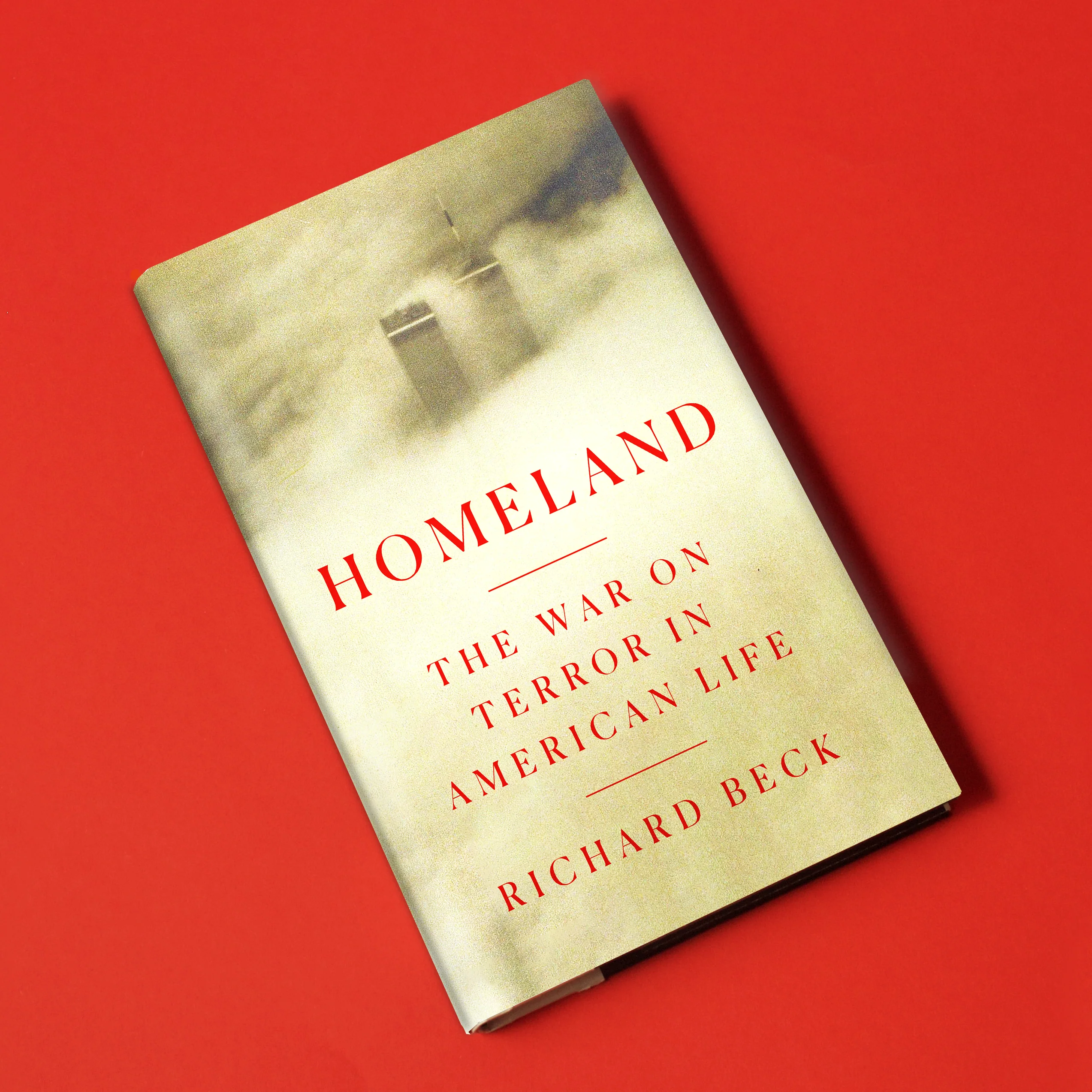
Reviewing Homeland: The War on Terror in American Life
I don’t buy hardcover books, and I don’t buy new books. My library is built out of $3 Amazon finds, little free library volumes, roadside boxes of abandoned novels. But when Richard Beck’s Homeland: The War on Terror in American Life released a few weeks ago, I ended up calling three or four Barnes and Nobles just to find a copy. I couldn’t even wait for Amazon to ship me one. At 8pm I made the hour trek out for the nearest location with Beck in stock; I was the last sale of the night, I think, and the woman who checked me out did so through clenched teeth.
Why the change? I justified the hurry and expense to myself by claiming Homeland would help me with my thesis research. This is plausible, and mostly true. But what would have stopped me from pirating a digital copy (as I shamefully do with many new releases)?
The answer has something to do with the impressive gravity of Beck’s project, here- almost 500 pages that map the near complete effects of the war on terror in the US and that contains everything from a history of Italian city-state capitalism to close reads of 24, Toyota ads, and Super Bowl Halftime shows. Beck, in a manner that simply must be inspired by Slavoj Žižek, displays an almost kaleidoscopic arrangement of elements in building his argument; no event, no detail escapes from Homeland; like a black hole, everything is subsumed into it.
And an argument this is: Beck does not pretend to sit back, neutrally- recall Zinn’s line about moving trains- but instead suggests a model for understanding the wide sweep of all American history. He establishes a through-line from the myth-inspiring days of the Indian wars to the brutality of Abu Ghraib (quite elegantly, I’ll add). That America is an empire is not up for debate, but Beck is doing more than rehashing tired conflicts. Deep down, what motivates American empire and conquest- even when, as Beck points out, the wars in Iraq and Afghanistan were not surprise failures but instead conceived so as to yield neither treasure nor glory- is a McCarthy-esque ambient desire for blood and subjugation. (If McCarthy ain’t your thing, substitute for Roth’s indigenous berserk). Beck isn’t suggesting that capitalism isn’t a primary motivator here, just that the mechanisms of capital have been instead appropriated to incentivize and produce violence. This is a truly impressive accomplishment- especially to smuggle into what’s ostensibly a more focused volume.
And therein lies the issue. From a reading physics level, Homeland is overwhelming, and in some places, its digressions simply seem digressive, rather than constituents of Beck’s grand collage.
But Homeland is a grand work, readable, sweeping, cohesive (somehow!), and deeply disturbing. I loved it.
Leave a Reply