
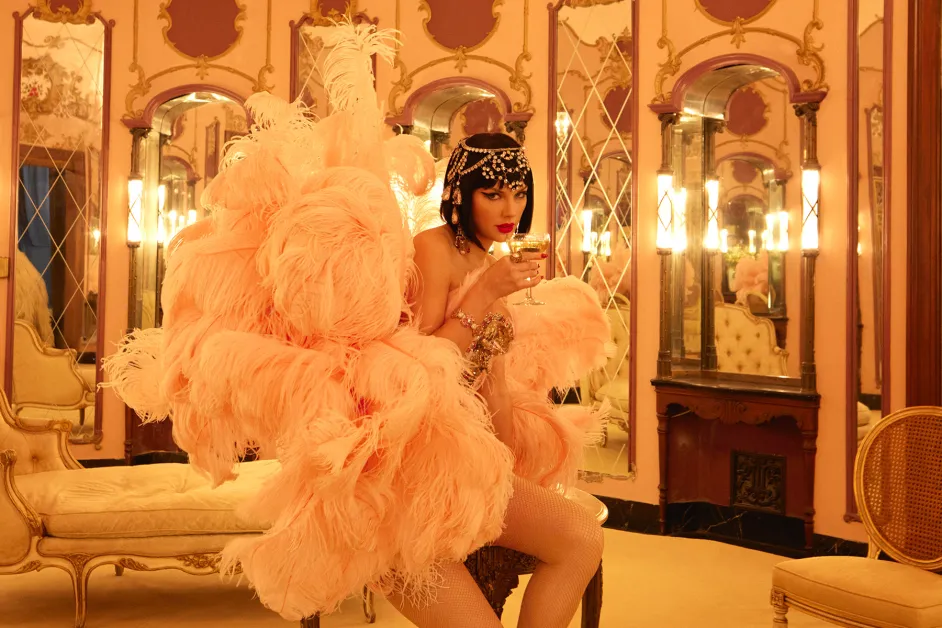
Taylor Swift’s twelfth album, The Life of a Showgirl, marked another streaming milestone in the singer-songwriter’s career, earning nearly 250 million streams during its first day on the Spotify charts—her second biggest debut following The Tortured Poets Department. While the numbers are impressive, it is clear they are hardly an indicator of interesting material.
The album, announced on Travis and Jason Kelce’s “New Heights” podcast, features thirteen tracks produced by Max Martin and Shellback and built around a Cabaret and burlesque inspired aesthetic. Despite Swift’s suggestions that the album would exhibit the same immersive lyricism of folklore, with beats akin to those of 1989, The Life of a Showgirl instead delivers the very opposite: comically out of touch verses and lackluster innuendos sustained by forgettable melodies. While one of the common pitfalls of Swift’s work is cohesiveness, The Life of a Showgirl has left audiences searching for any connection between the glamorous aesthetic of the album photoshoot and the Wives-and-Girlfriends fantasies and celebrity feuds she proceeds to sing about.
Taylor Swift’s Life of a Showgirl, track by track
The album opener and lead-single “The Fate of Ophelia,” makes reference to the tragically destined noblewoman of Hamlet, whose drowning was the result of the patriarchal actions and belief systems of the men in her life—and whose death is said to symbolize the retrieval of her own autonomy. For all of the possible comparisons Taylor Swift could have made about personal agency, or wanting to free herself of a narrative cultivated by those surrounding her, she instead reduces the point of the story by implying that Ophelia was a damsel locked in a tower and that her outcome might have been different if a tight-end from the Kansas City Chiefs had simply rescued her from her own mind. An incredibly poor interpretation, coming from a self-proclaimed English teacher.
Swift continues her comparisons in “Elizabeth Taylor,” paying homage to the Hollywood star’s life and likening it to her own, whether through their experiences of mass scrutiny or tumultuous love lives. Sonically, the second track resembles the instrumentals of “reputation,” offering a bit of momentum that holds through the upbeat and glittery energy of “Opalite”—a fun, rom-com-esque song that knows not to take itself too seriously. Music CEO Scott Borchetta and label executive Scooter Braun are speculated to be the subjects of “Father Figure”, where Swift interpolates the initial George Michael song and alludes to the reclamation of her masters and early days in the music industry. Despite the safe, retail-playlist feel of the first four tracks, each feel true to Swift’s lyrical and musical style.
Where Taylor Swift falters
“Eldest Daughter” marks the moment the album takes a nosedive, as Swift aims for vulnerability, but lands on something whiny and awkward. What is traditionally the most poignant track of her albums, this track five instead features lyrics such as, “I’ve been dying just from trying to seem cool / But I’m not a bad bitch / And this isn’t savage / But I’m never gonna let you down.” While the point may have been to convey that Swift fears her insecurities and expectations will hinder her relationship, the lyricism—despite its allegedly flippant intent—instead comes across as almost aggressive, earning eye rolls across the board. “Ruin the Friendship,” on the other hand, redeems some of the emotional depth that “Eldest Daughter” lacks. Highlighting Swift’s regret over missed chances through the death of a close friend, she encourages audiences to take their chances, as tomorrow is never promised, but lacks the memorable melody that appeared on the first four tracks.
“Actually Romantic” is another source of controversy. It opens with the lines, “I heard you call me ‘Boring Barbie’ when the coke’s got you brave / High-fived my ex and then said you’re glad he ghosted me / Wrote a song saying it makes you sick to see my face / Some people might be offended / But it’s actually sweet / All the time you’ve spent on me,” a response to singer Charli xcx’s “Sympathy is a knife”. The latter is from the 2024 album Brat, about the complicated emotions of being a woman in a competitive industry next to someone with astronomical levels of success and fame, and the insecurity and envy that can engender. Swift’s rebuttal is catty and low, particularly when she masquerades as a forward-thinking feminist who wants to look out for her female peers.
The lyrics “Like a toy Chihuahua barking at me from a tiny purse / that’s how much it hurts…” are undermined by the simple fact that she wrote and released a whole song instead of letting the remark slide. “I mind my business, God’s my witness that I don’t provoke it / It’s kind of making me wet…” drips with the pettiness of a woman plagued by arrested development and an inability to accept any commentary apart from praise. (Yes, it is important to remember that both women will know more about each other than the rest of us. Swift has a tendency to continuously stoke the flames on bridges she wants us to believe she has burned.) What’s worse, is that in response to being called “boring,” she then gives us a song that is exactly that.
“Wi$h Li$t” and “Wood” direct the spotlight towards Taylor Swift’s relationship with Travis Kelce, delving further into their romance and hopes for their future (“I just want you, huh / Have a couple kids, got the whole block looking like you / We tell the world to leave us the fuck alone, and they do, wow”). Still, there’s an irony that comes with a woman with several multi-million dollar mansions claiming to pay no mind to the more materialistic aspects of life. A recurring theme of Swift’s discography is her search for a lifelong love, but “Wi$h Li$t” is an uninspired and condescending capstone.
Considering the growing conservatism in pop culture—through the ‘trad wife’ and resurgent belief that a woman’s value comes from marriage and motherhood—the subsequent turn in Swift’s messaging raises eyebrows. So often has she been called a “childless cat lady” by right-wing commentators– a label she reclaimed and championed!– the lines, “They want those three dogs that they call their kids” and “They deserve what they want / I hope they get what they want / I just want you” are puzzling, to say the least. It begs the question of where Swift’s true beliefs lie—especially if she is saying that this album represents her at her most authentic.
Nevertheless, Taylor Swift is evidently happy and secure after years of heartbreak and she is allowed to write music with simple and occasionally saccharine lyrics…that being said, those lyrics should still have some substance. In “Wood,” she sings: “The curse on me was broken by your magic wand / Seems to me that you and me, we make our own luck / New Heights of manhood” and “Forgive me, it sounds cocky / He (ah!) matized me / and opened my eyes / Redwood tree it ain’t hard to see / His love was the key / That opened my thighs,” fail to hold anything or pull off any sort of clever innuendo in the way that some of her musical peers are able to.
Instead, Swift’s word choice leaves audiences listening with a baffled shudder—and also wondering why the lyrics have been put over a production that sounds like a direct cut from The Jackson 5’s “I Want You Back”. She has evidently been spending time with Sabrina Carpenter, known for her comedic double entendres. “Wood” shows that Swift is chasing that same phenomenon, but lacks the wit to be able to stick the landing. There is none of that dry subtlety that makes it fun; instead, the analogies are weak and ditzy.
“CANCELLED!” is a new low for Swift’s catalogue, with embarrassing lyrics such as “Did you girlboss too close to the sun?” and “Good thing I like my friends cancelled / I like ‘em cloaked in Gucci and in scandal” and “Welcome to my underworld / Where it gets quite dark / At least you know exactly who your friends are.” Considering that, in recent years, Swift has surrounded herself with people who aren’t the most saint-like—and not just by the internet’s standards— her fans’ valid criticisms are taken with nothing more than a smirk and the metaphors of teenage poet searching for some sort of bite has left behind a sour aftertaste. Swift continuing to push the narrative that she is a controversial, avant-garde artist– after winning Album of the Year four times and completing a world tour that generated almost $2 billion dollars– is absurd and objectively untrue. One would think Swift is aware that such levels of success are accompanied by a certain amount of criticism, warranted or otherwise, but…
“Honey” is another catchy love song that gets somewhat lost amid the chaos of the rest of the album, but the lines “When anyone called me ‘sweetheart’ / It was passive aggressive / At the bar / And the bitch was telling me to ‘back off’ / Cause her man had looked at me wrong” are interesting, given that a large factor of Swift’s hiatus between 1989 and reputation was being called a ‘bitch’ and a ‘snake’ herself. She’s obviously grown comfortable with the term, given the amount of times it appears throughout the album, but then, like most aspects of Swift’s activism, some issues are only important or hurtful when they apply to her specifically; low barbs disguised as clever retorts—good. An offhand remark or less than adoring look—bad.
The album wraps up with a collaboration with Sabrina Carpenter: “The Life of a Showgirl’ —which, funnily enough, is perhaps the only song that actually fits the supposed theme of the album. The song aims to explore the facade around fame, a topic Swift has delved into before, but the message is becoming increasingly tired and out of touch when it’s from a woman with a net worth of $1.6 billion. Perhaps that is one of the reasons The Life of a Showgirl as a full album also falls flat: the excessive multi-colored vinyls, the alternate versions to generate further streams, the glitz and glamor of the photoshoot only to provide something less than mediocre—it reeks of a financial hunger that Swift is failing to satisfy.
Is this even the same Taylor Swift?
Taylor Swift’s initial appeal was that she was an artist dedicated to the craft and sought agency over her work while staying down-to-earth. She was capable of producing music that spanned multiple genres and showcased impressive lyrical prowess. Even if her vocals or choreography were not always comparable to that of her contemporaries, they could be somewhat overlooked because the songwriting was her signature trait. Swift’s best work has always transpired when she has something to prove: Speak Now was almost entirely self-written following the allegations from critics that she was incapable of writing songs on her own; 1989 followed the Grammy’s snub of Red and marked Swift’s full transition from country to pop. reputation showcased her thoughts on the media narrative surrounding her while falling in love; folklore and evermore were two raw, emotive albums that blended fiction and reality in a poetic manner that Swift has been chasing since.
The Life of a Showgirl is what happens when Taylor Swift has nothing fresh or relevant to add to the current musical landscape but cannot bring herself to pass on the spotlight. Most artists make an effort to space out their album releases in order to ensure quality material, but Taylor Swift has hardly gone a year without an album release since 2020. She thrives on domination, yet cannot refrain from reminding us just how difficult it is to be famous, and to try being her for a day. Gone is the artist who made an effort to speak out on issues that she claimed mattered to her (seriously, releasing Miss Americana, an entire documentary on the importance of using one’s platform and voice to incite change followed by radio silence?) and who created art that felt authentic; she is instead revealing herself to be the very character she has always said to resent—self-absorbed, cynical and pretentious.
Fans of The Life of a Showgirl have suggested that the album is satirical and tongue-in-cheek, raising questions about Swift caricaturizing herself. They might have a point, but there still must be a level of acceptance that is shown when our idols don’t always hit the mark—or when they miss it entirely. The idea that Taylor Swift must remain in a dark and brooding headspace to create meaningful work isn’t true, but her work should still provide something worthwhile if her fanbase wants to continue bestowing the “lyricist of a generation” title upon her. It is clear Swift is exhausted creatively and is failing to meet her own standards. After all, streams and sales do not negate the fact that her album and brand are failing to keep up with the rapidly changing pop and artistic landscape. Her level of fame and wealth has prevented her from being able to produce music that is either interesting or understandable, and it is hard to believe that anyone would begrudge her a hiatus, and perhaps afterwards, she’ll be able to think about her next steps before blindly falling into them.


Leave a Reply