
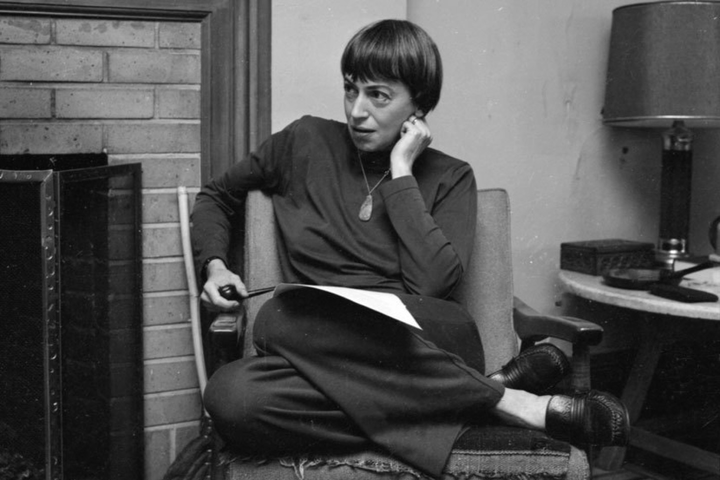
I’ve been reading Le Guin, and I’ve been thinking a lot about how our society reacts to progressive ideas, especially as the American socio-political landscape grows more taut. Why is a country that prides itself on freedom so intolerant of new concepts that would expand those liberations? Gender, for example, has sparked a lot of controversy. Fortunately, as a cisgender woman, I’ve not experienced the destructive effects of bigotry as people whose gendered experience is less traditional. That being said, I’m still a woman who understands the inequality of sex, and the emphasis our world places on those enforced roles.
Ursula Le Guin’s The Left Hand of Darkness explores gender as a binary sociological structure through its depiction of a totally alternate gendered reality. Le Guin emphasizes the disparities within a society divided and ruled by gender through presenting an alien species, the Gethenians, whose sexual counterparts are not predetermined, but rather, take form during sexually active cycles (known as “kemmer”). Their genitals alter depending on who their sexual partner is. Because of this, Gethen is not inhibited by gendered expectations in the same way we are now. A person’s femininity wouldn’t be indicative of being a woman. Masculinity wouldn’t, therefore, be the equivalent to being a man. I strongly resonate with Le Guin’s experimentation because it speaks to how highly we value gender and sex, and her illustration challenges those ideas.
Le Guin employs the contrast between Gethen and Earth to emphasize the negative effects of a binary system of gender’s stunted relationship to gender expression. For example, when Genly, a human male sent as a diplomat to Gethen, and Estraven, a Gethenian native, are stranded together amidst a blizzard, Genly gets sick and rejects the help the Gethenian offers because of his internalized views about manhood. To him, men aren’t supposed to accept help (especially from other masculine people) because of their socially understood role as providers. Providers shouldn’t be provided for. However, in Gethenian society, there are no standards of expression that someone must meet to be considered a certain sex, nor are they defined by being or having the specific counterparts that align with a particular binary. He suffers in the name of upholding a role he no longer even needs to fulfil, being that he lives on Gethen–not on Earth where these roles have unwarranted significance–when this takes place. It makes me question the way our society might operate if we didn’t place such importance on gender. In abandoning gender roles, we may also experience sexual liberation, too. Moreover, I think there would be a lot less turmoil and division in social settings if we allowed more freedom in individual expressions.
To rescusciate my earlier point, what does it mean to be a certain sex? Performance and gender are so essential to our world’s comprehension of gender, but also extremely reductive. These restrictive roles invite harm and bigotry and intolerance. I hear more and more horrifying stories of people being followed into public bathrooms and asked to “prove” their gender and the right to use the facility. Truthfully, I don’t think the toilets care that much, so why should we? Not a soul in Le Guin’s Gethen would’ve done something so invasive to another of theirs. What would happen if we just stopped caring so much about our peers’ genitals? Maybe, femininity and masculinity don’t have to correlate to a specific gender or sex. I think it would solve a lot of social issues if our idea of gender was more lenient and open. Le Guin’s experiment with Gethen, in her creation of a society unharmed by gendered roles, highlights conflicts within ours that should be addressed. More than that, and I say this as someone with a deep passion for written art,The Left Hand of Darkness is a phenomenal example of literature’s expansive impact and ability to challenge the status quo.
Leave a Reply