
[This post was repurposed from an essay written in the past.]
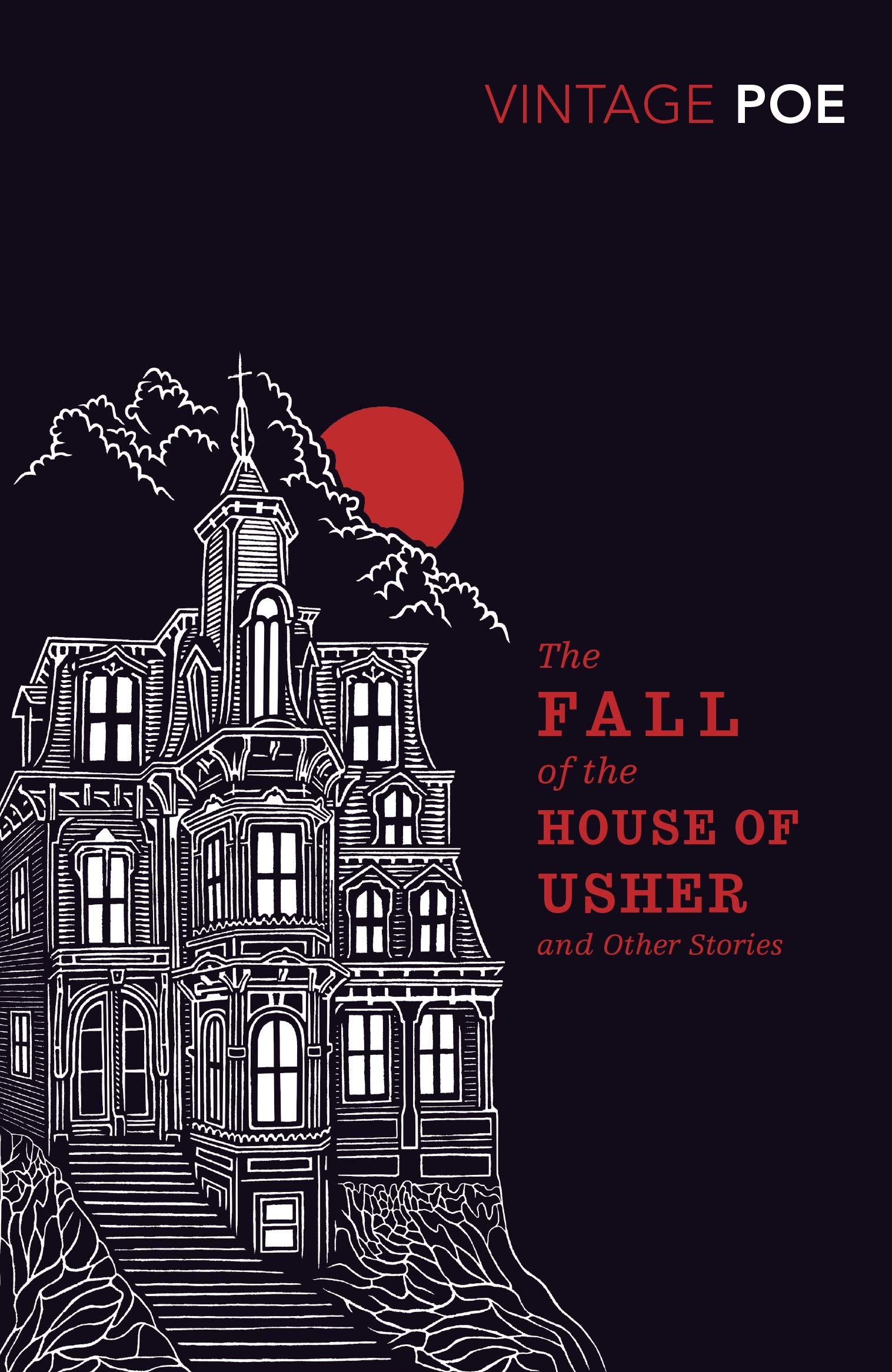
Edgar Allan Poe’s “The Fall of the House of Usher” ruminates largely on the subjects of imagination, intuition, fiction, and the immaterial reality of those things, directly connecting them to the physical world of the story. Throughout the story, the narrator is constantly confronted by fiction, whether that be his own paranoid imagination, much of the books he pores over with Roderick, and the final story of the “Mad Trist” he tells Roderick. Ultimately, all of these fictions become truth, always juxtaposing the narrator’s own skepticism to his chagrin. Even the song that Roderick sings, “The Haunted Palace,” spells out the events of the story in verse. This use of fiction to foreshadow events in the story suggests the narrative that fiction dictates reality.
The narrator’s imagination is often dismissed by himself throughout the story, though his intuitive assumptions seldom ring false. Immediately upon approaching the House of Usher in the first paragraph of the story, the narrator is seized by “an iciness, a sinking, a sickening of the heart—an unredeemed dreariness of thought which no goading of the imagination could torture into aught of the sublime” which confronts the reader with the incontrovertible idea that the narrator cannot shake how evil the house seems. However, he does, countering his own suspicions with a new explanation pulled out of thin air, that “there are combinations of very simple natural objects which have the power of thus affecting us, still the analysis of this power lies among considerations beyond our depth.” While the narrator is attempting to refute his own paranoia here, he in a separate way is confirming his own suspicions. His hypothesis at face value states that these combinations of objects can affect people just by the way that they’re arranged, and that any more meanings ascribed to these powers of imagination are likely frivolous. “It is possible, I reflected, that a mere different arrangement of the particulars of the scene, of the details of the picture, would be sufficient to modify, or perhaps to annihilate its capacity for sorrowful impression” he says, ascribing psychological rhetoric to his own intuition. However, he also states in the first sentence that “the analysis of this power lies among considerations beyond our depth.” Acknowledging that he cannot understand why this feeling exists is strange, given that directly following this acknowledgement he attempts to find the solution to the problem he just said cannot be solved. In his attempts to “annihilate its capacity for sorrowful impression” and invoke rationality and skepticism in the face of intuition and imagination, the narrator is confronted with his paranoid intuition only being reinforced as he attempts to reconsider the manor, but only sees “the remodelled and inverted images of the gray sedge, and the ghastly tree-stems, and the vacant and eye-like windows.” His imagination is almost immediately confirmed by the narrator himself. Similarly, the narrator speaks at length about his own philosophy regarding the “experiment” he performs before entering the manor. He says that “such…is the paradoxical law of all sentiments having terror as a basis” regarding his thoughts on his own superstition increasing, as he wants to further seek out that terror. His story and that of Roderick Usher’s are self-fulfilling prophecies.
Once again, topics of fiction dictating reality return when Roderick Usher sings the fitting titled “The Haunted Palace” for the narrator. The narrator himself mentions that Roderick’s “dirges” are “long improvised” and “wild fantasias,” implying that Roderick himself is using imagination in particular to conjure up the intuitive prophecy that follows. Largely, the song “The Haunted Palace” fits the rest of the story and the inevitable fates of the Ushers. In the song itself, a royal palace is eventually taken over by evil, killing the monarch and abandoning the palace to ruin, much like how the rest of “The Fall of the House of Usher” plays out. It’s important to see the Usher family specifically as one of artists, namely musicians, as the narrator plainly states earlier in the story: “I was aware, however, that his very ancient family had been noted… in many works of exalted art… and easily recognizable beauties, of musical science.” This artist, in comparison to the man of rationality that is the narrator, plays the role of prophet. Roderick is no different from this depiction of an artist, as the family has “very trifling and very temporary variation,” and Roderick is a gifted songwriter, guitar-player, and painter. In the lament situated as the midpoint of the story, Roderick tells a tale that is eerily similar to himself and the later happenings that befall him. The poem’s first two stanzas describe the estate as “yellow, glorious, golden” and as having a “gentle air” and “winged odor,” located within the “greenest of valleys” and populated by “good angels.” This largely falls in line with not just the narrator’s own memories of his and Roderick’s “boon” companionship, but also of the family’s own “munificent yet unobtrusive charity” and their “exalted art.” Both paint idyllic, dreamlike scenes that happened before the events of either story being told. In the third stanza of the song, Roderick seems to implicate that he is the one being seen through the “two luminous windows,” as much like the family’s own musical sensibilities and Roderick’s own skill with the guitar, a lute, another stringed instrument, is heard within the palace. Likewise, there is seen a “porphyrogene,” also known as a porphyrogenite, or the son of a king, which fits Roderick quite well as the son of a very rich family. The fourth stanza is similarly inclined, with Grecian Echoes coming in to sing for the king, much as the family itself were rapt with music, likely spurred on by each ancestor going down the family tree. In the final stanzas of the poem, “evil things…[assail] the monarch’s high estate” and doom the palace to a gloomy entombment similar to the House of Usher’s own mummification at the middle of the tarn. Finally, the last stanza seems to suggest travelers, like the narrator, can see ghosts inside the palace, and that those ghosts will send “a hideous throng [to] rush out forever.” The similarities here suggest the Usher siblings, with Roderick first being described as having a “ghastly pallor” and “gossamer” hair, and Madeline first being described as passing and disappearing through the building like a ghost. Then, at the end, when Madeline breaks free from her tomb, a “rushing gust” throws the door of her crypt aside much like the “hideous throng” at the end of “The Haunted Palace.” Largely, it is Roderick’s fearful intuition that things will go wrong in the House of Usher. The narrator has several moments where he is worried or scared of the house, but he largely dismisses these beliefs. Roderick’s fiction, superstition, and opinions are what spells doom for the House of Usher.
At the conclusion of “The Fall of the House of Usher” and the Usher house itself, the narrator sparks the night’s end by sitting down and reading a book titled “Mad Trist.” This is a fictional book made up by Edgar Allan Poe, written by the fictional “Sir Launcelot Cunning.” Another instance where books foreshadow the events of the story are when Roderick and the narrator choose to read books on the occult, demons, mythology, and the supernatural, which clearly pave the way for the directly supernatural occurrences at the story’s ending. The “Mad Trist,” however, is largely a classic hero story about a knight slaying a dragon. The title of the tale is considerably strange for a book about a knight slaying a dragon, however, as a “trist” denotes something sorrowful. This strange title describes two things: not only the name of the town where the hero Ethelred resides, but also an insane sorrow, which describes Roderick perfectly. It’s ironic, then, that “Mad Trist” is what the narrator picks in an attempt to save Roderick from his panicked stupor. It is important that the hero Ethelred shares little-to-nothing in common with the protagonists of “The Fall of the House of Usher,” being a brave, strong adventurer. His attacks in the following pages of “Mad Trist” do not, therefore, denote actions done by the protagonists, but rather of some unseemly supernatural force within the house itself, Madeline, or the house itself. In “Mad Trist,” it appears that the hermit shares more in common with Roderick, being of “obstinate” and homeridden demeanor. During the story, Ethelred attempts to break into the hermit’s house to seek shelter from the raging storm outside, much as a storm plagues the Usher manor that night. While Ethelred is breaking the door down, the narrator notes a similar “echo (but a stifled and dull one certainly) of the very cracking and ripping sound which Sir Launcelot had so particularly described.” This sound is undoubtedly the sound of Madeline breaking free from her coffin. When Ethelred enters, he comes upon an illustrious hoard of gold hiding within a palace much like the one the first two stanzas of “The Haunted Palace” discuss and, therefore, much like the Usher estate itself. As Ethelred kills the dragon, it shrieks, and the narrator hears “the exact counterpart of what [his] fancy had already conjured up for the dragon’s unnatural shriek as described by the romancer.” In that sentence, two things are at work: imagination in fancy, and the writer, Sir Launcelot Cunning. The two work in conjunction to create reality out of fiction, the writer describing a shriek, the narrator conjuring his own version of the shriek from the author’s description, and then that shriek created by the two of them together becomes irrefutably real. As the narrator puts it, it is “exact.” The narrator is beset by “wonder and extreme terror” together, his terrible self-fulfilling curiosity returning. Ethelred retrieves the shield, and the narrator hears “a distinct, hollow, metallic, and clangorous, yet apparently muffled, reverberation.” It is here that the narrator is driven to terror, and Roderick is driven mad.
Roderick’s final speech is the ultimate horror. Previously, he discussed the “sentience of all vegetable things” and that the evidence of such was to be seen. When Madeline breaks free, Roderick’s evidence is finally found. Madeline is certainly dead, covered in blood and having been trapped within an airless metal coffin for multiple days. Her corpse has come to life, and much like Roderick’s theory of sentience is predicated upon “the gray stones of the home of his forefathers,” the house itself appears to come to life to free Madeline. As Madeline is freed from a dungeon where there is so little oxygen flames flicker, and sealed underneath the manor, there is no chance that the storm or any outside force is what freed her. Given the above, it must be an inside force or the house itself that has freed her, as it is often described as living with “eye-like windows” and as being covered in a fungi that hangs “in a fine tangled web-work from the eaves,” much like Roderick’s own web-like hair. It is Roderick’s final speech where he acknowledges the “Mad Trist” come to life, his fear turning him to screaming. As the narrator says, it is “as if in the superhuman energy of his utterance there had been found the potency of a spell, the huge antique panels to which the speaker pointed threw slowly back, upon the instant, their ponderous and ebony jaws.” In this instance, Roderick creates reality with merely his words and his fear. His fearful predictions have become the reality. The fiction of the world has created its sad end.
The narrator of “The Fall of the House of Usher” seems to suggest, initially, that his practicality is what serves him the best. His exercises in opined perception are, as he puts it, “childish,” and he says that Roderick’s fears and predictions are frivolous, if judging his reading an “uncouth” tale to assuage fear from Roderick’s panic by the windows. However, the narrator is proven wrong in his rationality by the end of the story, and Roderick is proven right. The manor is pulled into the tarn and Roderick is killed. “‘I shall perish,’ said he, ‘I must perish in this deplorable folly,’” and Roderick’s augurings could not come more true. Foreshadowing in this tale is found within imagination, between pages, and along musical notes. In the world of the Usher estate, fear is not a mere inclination of the paranoid to folly; it is a harsh reminder of the inevitable surfacing of fiction in reality.
Leave a Reply